M78 Nebula (NGC 2068): A Subtle Reflection Nebula in Orion
While the Orion Nebula (M42) gets most of the attention, a rewarding and more challenging target nearby is Messier 78 (M78). M78 is one of the brightest and most easily observed reflection nebulae in the night sky. It is the brightest of the group of reflection nebulae it belongs to in the Orion Molecular Cloud Complex.
The Orion Molecular Cloud Complex, is the same giant star-forming region that includes M42, Barnard’s Loop, and numerous dark nebulae.
- Catalogues: Messier 78, NGC 2068
- Constellation: Orion
- RA/Dec (J2000): 05h 46m / +00° 05′
- Distance: ~1,350 light-years
- Angular size: ~8 × 6 arcminutes
It was discovered by Pierre Méchain in 1780 and later included in Messier’s catalogue.
M78 is a reflection nebula, not an emission nebula. The dust grains scatter light from nearby stars, preferentially scattering shorter (blue) wavelengths.
The main illuminating stars are:
- HD 38563A
- HD 38563B
Both are young, hot B-type stars embedded in the cloud. Their radiation also sculpts the surrounding gas and dust into filaments and cavities that become apparent in long-exposure images.
Although M78 appears smooth in visible light, infrared surveys show it is actively forming stars. Observations with Spitzer, Herschel, and JWST reveal:
- Embedded protostars
- Herbig–Haro objects from stellar jets
- Dense molecular cores
This makes M78 a useful laboratory for studying early stellar evolution and star-cloud interactions in a relatively nearby molecular cloud.
M78 is not difficult to observe, but it is much fainter than M42 and benefits from dark skies.
Recommended Conditions
- Sky: Dark, transparent skies (Bortle 4 or better preferred)
- Season: Best in summer evenings in New Zealand (Dec–Feb)
- Seeing: Not critical; transparency matters more
📸 Imaging Notes
M78 is a popular astrophotography target:
- Best captured with broadband RGB imaging
- Narrowband filters are ineffective
- Long integration times reveal surrounding dark dust lanes and faint blue nebulosity
Wide-field images show M78 embedded in a much larger network of molecular clouds, including NGC 2071 and NGC 2064 nearby.
📚 References and Further Reading
- NASA – Messier 78 Overview
https://science.nasa.gov/mission/hubble/science/explore-the-night-sky/hubble-messier-catalog/messier-78/ - SIMBAD Database – NGC 2068 (M78)
http://simbad.u-strasbg.fr/simbad/sim-id?Ident=NGC+2068 - Wikipedia – Messier 78
https://en.wikipedia.org/wiki/Messier_78 - https://www.messier-objects.com/messier-78/
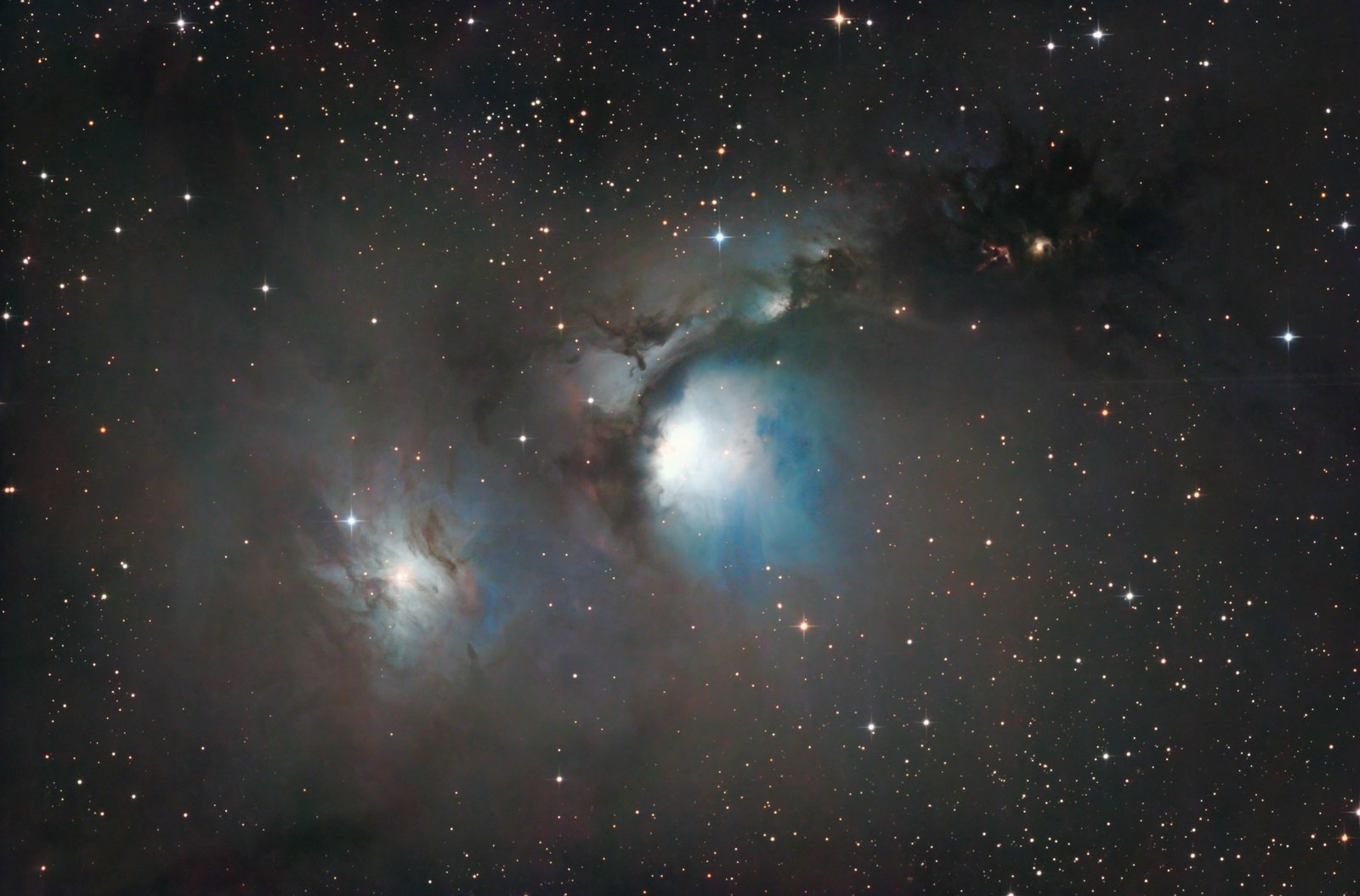
Image of M78 captured from Brightwater using a Skywatcher Quattro 300 F4 Newtonian, EQ8RH-Pro Mount, QHY268M camera and RGBL images stacked and processed in Pixinsight.
Leave a Reply